Costa y Campo
Blog

Benidorm Cross: Route To the Top

There comes a moment, somewhere around the halfway point of the climb up to La Creu, when Benidorm stops being a resort and becomes something altogether different.

The noise of the strip fades, the traffic dissolves, and all that remains is the soft crunch of your footsteps on the tarmac, the rustle of Mediterranean pine, and — if you pause, turn, and truly look — one of the most audacious urban panoramas in all of Europe spread out behind you like a fever dream of concrete and cobalt sea.

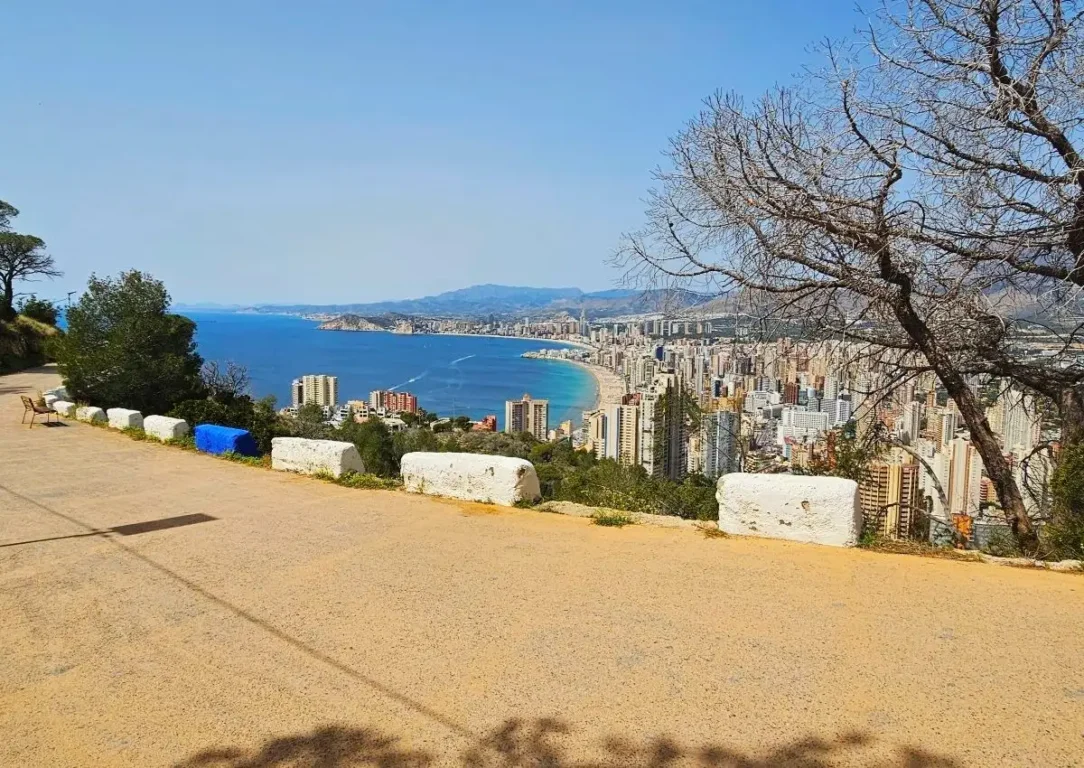
Benidorm Vista from above.

Benidorm Vista from high above

The Cross — La Creu in Valencian, La Cruz in Castilian Spanish — is Benidorm’s most meaningful landmark that most visitors never reach.

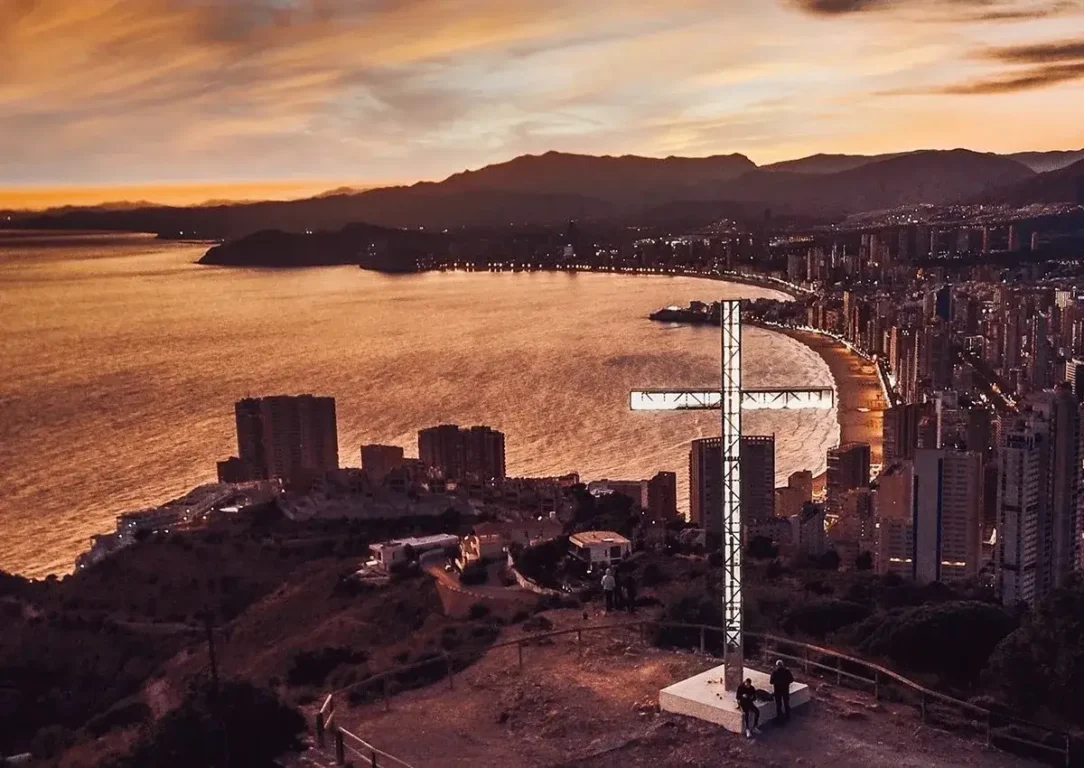
It stands at the southern tip of the Sierra Helada Natural Park, roughly 217 metres above the turquoise waters of the bay, visible from much of the resort day and night, lit dramatically after dark.

Benidorm Cross illuminated at night.

Neon Lights

It has watched over this town for more than six decades, and the story of how it got there is as singular and surprising as Benidorm itself.

A Cross Born of Bikinis & Bishops

History & Mission

It is 1961. General Franco’s Spain is cautiously opening itself to the outside world.

Benidorm — then still a modest fishing town beginning its extraordinary transformation into a global tourist magnet — has received special dispensation from the regime to allow foreign visitors to wear bikinis on its beaches.

For the Bishop of Orihuela-Alicante, this is nothing short of spiritual catastrophe.

In a moment that perfectly encapsulates the collision between Old Spain and the brave new world of package tourism, the bishop reportedly threatened to erect a sign at the town’s entrance reading simply: “El Infierno” — Hell.

Wiser counsel prevailed.

Instead, the Franciscan missionary Father Salvador Perona organised a week of religious acts — the “Gran Misión” — culminating in an extraordinary act of communal penance.

On the final day, the entire town — men, women and children — processed through the streets of the Old Town, collected a heavy wooden cross from the Church of San Jaime, and carried it on their shoulders all the way up to the peak of the Sierra Helada. That day became known as the Día del Perdón — the Day of Forgiveness.

The original wooden cross was replaced in 1975 — a storm sent it tumbling — and the current concrete and steel structure stands approximately six metres tall, visible from far out to sea and illuminated at night.

What began as an act of spiritual resistance has become, with magnificent irony, one of Benidorm’s most beloved tourist attractions.

The cross that was erected to condemn the holidaymakers now draws them in their thousands!

They say that if you haven't been to La Creu, you haven't truly experienced Benidorm. We'd go further — you haven't understood it.

The Benidorm Cross Walk

From Levante to The Summit

The walk begins where Playa de Levante ends — at the foot of the headland where the beach curves around and the skyscrapers thin out a little.

Keep moving along Avenida de Madrid until the junction becomes clear and you pick out the sign for Calle Alcalde Manuel Catalán Chana.
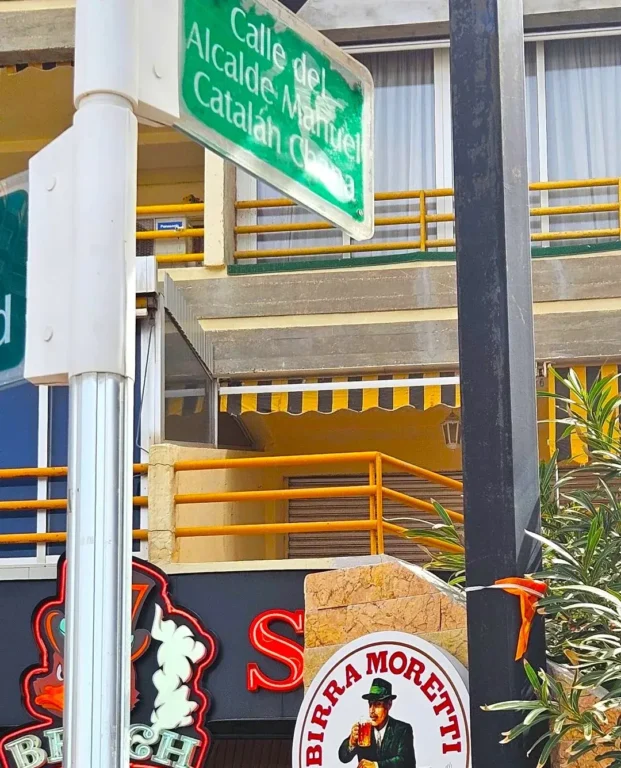
Benidorm Street Sign.

Calle Alcalde Manuel Catalán Chana

The street name, admittedly, is something of a mouthful — it honours a former mayor of Benidorm — but it is one of the most rewarding roads in the entire resort.

STAGE 1

Calle Alcalde Manuel Catalán Chana — The Gateway Street

Walk up Calle Alcalde Manuel Catalán Chana, just by the Wild Duck Beach bar, climbing gently eastward, skirting the base of the headland.

Almost immediately, the relentless noise and density of Benidorm’s new town begins to fall away.

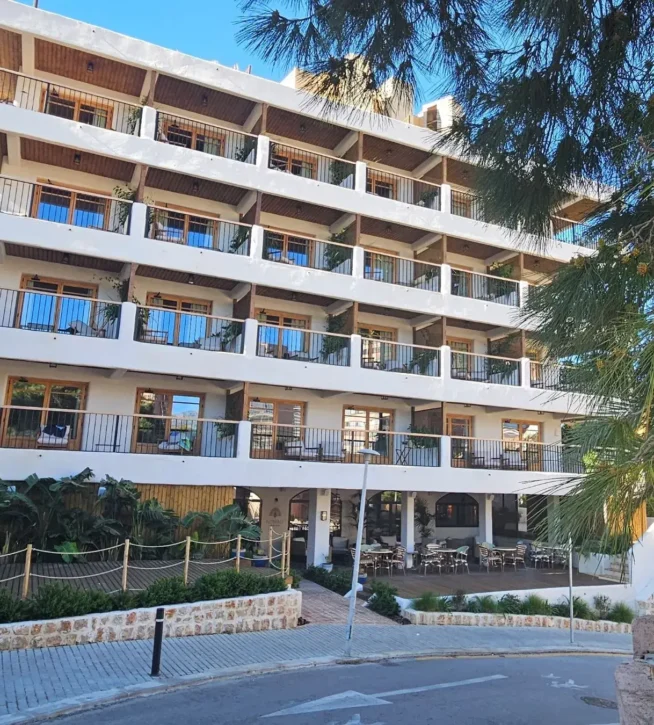
Residential apartment complexes and hotels — among them the striking Gemelos 28, one of Europe’s tallest residential buildings and Hotel Benikaktus — line both sides of the road, while to your right, through gaps between the buildings, the Mediterranean glistens.
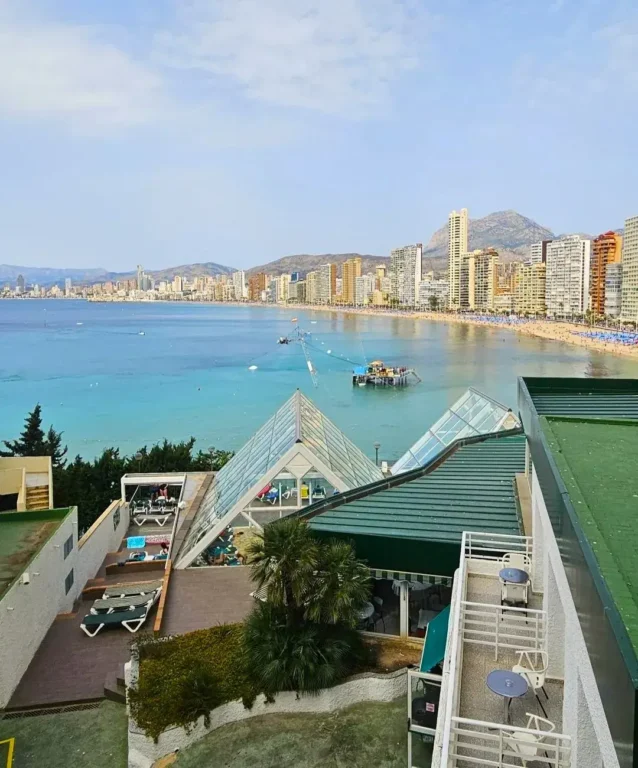
View of Hotel Benikaktus and Levante Beachi n the distance, Benidorm.

View from Hotel Benikaktus

Continue along this road, keeping the sea to your right.

And also keep an eye out for the occasional signpost directing you upwards in the direction of the Benidorm Cross.
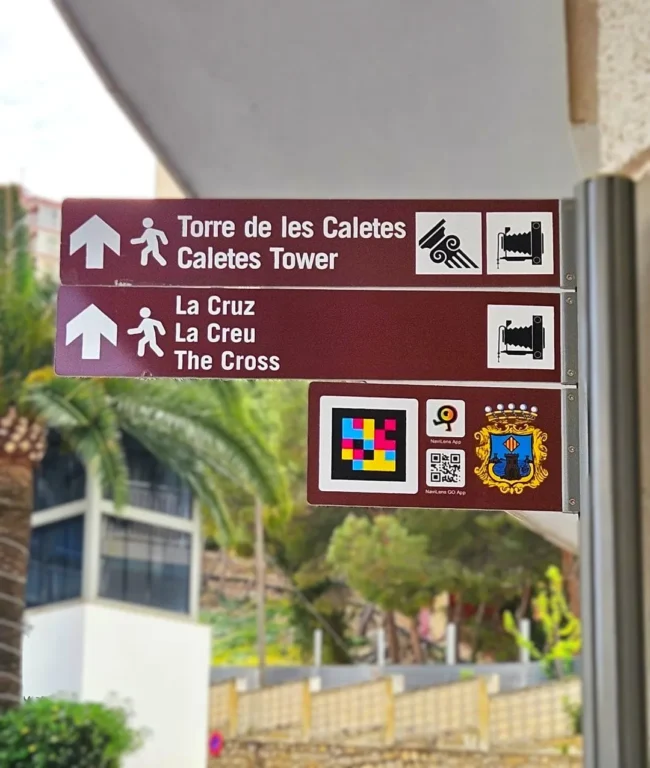
Signpost for Benidorm's La Cruz.

Signposting the way to La Cruz

As you keep walking you will pass Resturante Bahia Blanca on you right, just as you are about to spin around the bend, with the Mediterranean in full view and the Punta Llisera vantage point offering the perfect spot for a photo.

Keep following the curve of the road as it rounds the point. The horizon begins to expand. Ahead and above you, the terracotta-coloured escarpments of the Serra Helada Natural Park rear upwards in a series of dramatic limestone ridges.

While again to your right, barely visible from the road but a lovely detour if your legs are fresh, the pebbly cove of Cala de la Almadraba — one of Benidorm’s hidden coves where bathing suits are optional!
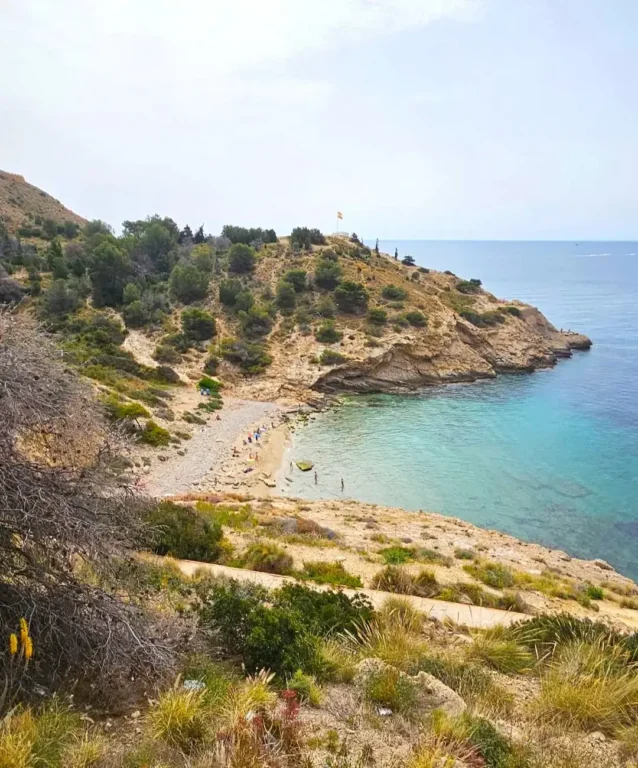
La Cala Almadraba, Benidorm.

Cala Almadraba – to wear or not to wear your swimwear!

Keep on moving up until you get to the intersection with Calle Sierra Dorada where a hairpin bend will have you doing a full 180 turn as the incline becomes a little steeper.
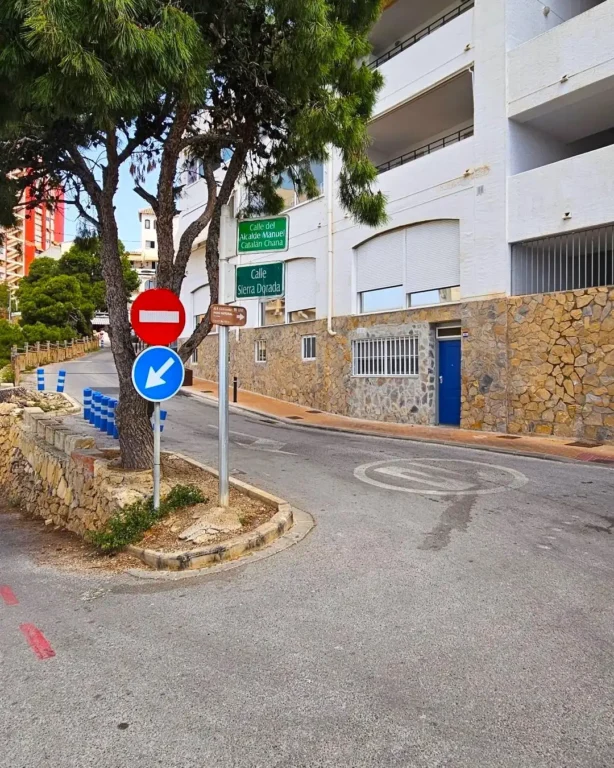
Calle Sierra Dorada, Benidorm.

Sierra Dorada Hairpin Bend

You might want to spend a few minutes, however, by going straight on along Calle Sierra Dorada which will take you to the famous Mirador Benidorm, a place for endless photographs of the Flag, the Sea and the Isle.
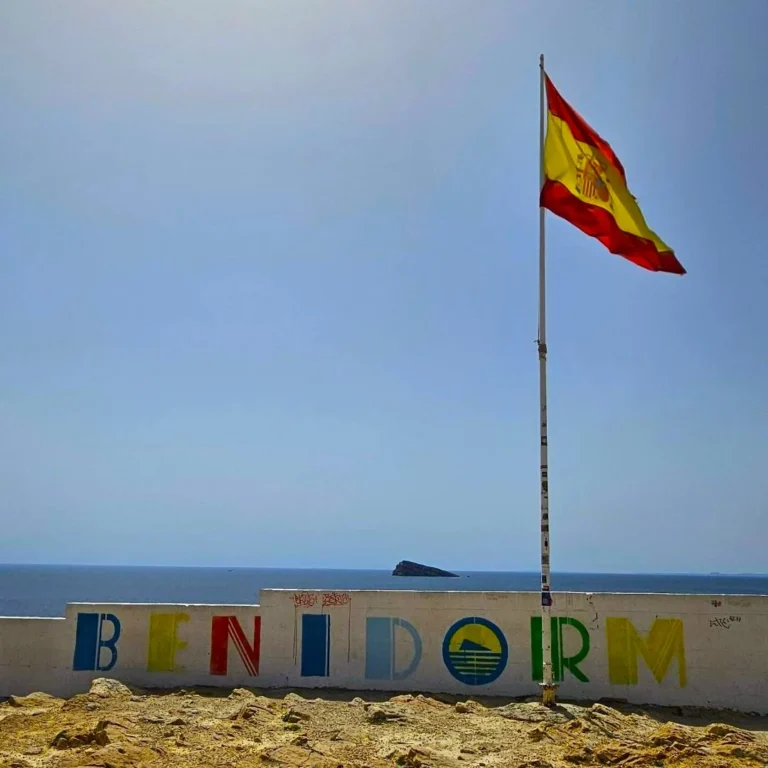
Mirador Benidorm.

Mirador Benidorm, the perfect photo op

Alternatively continue around the hairpin up the steep bank, still on Sierra Dorada, and head for a welcome pitstop.

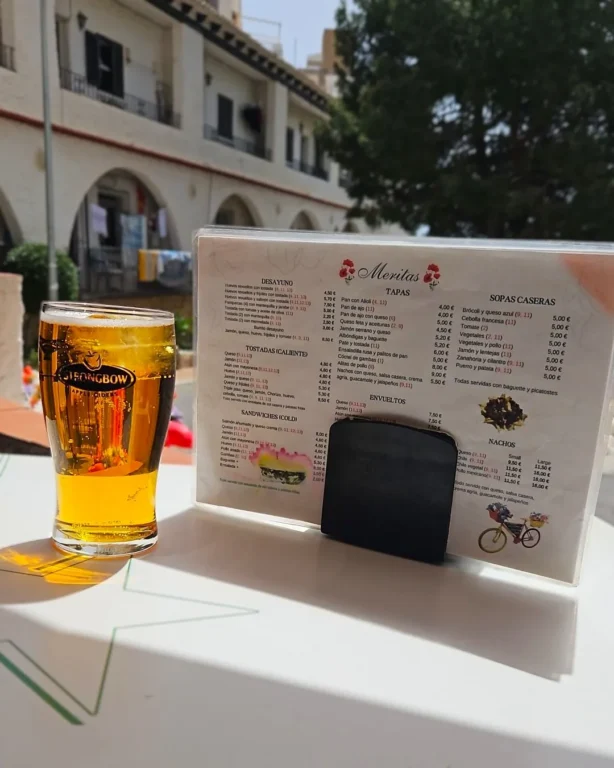
In a couple of hundred metres you will come face to face with Bar Meritas.
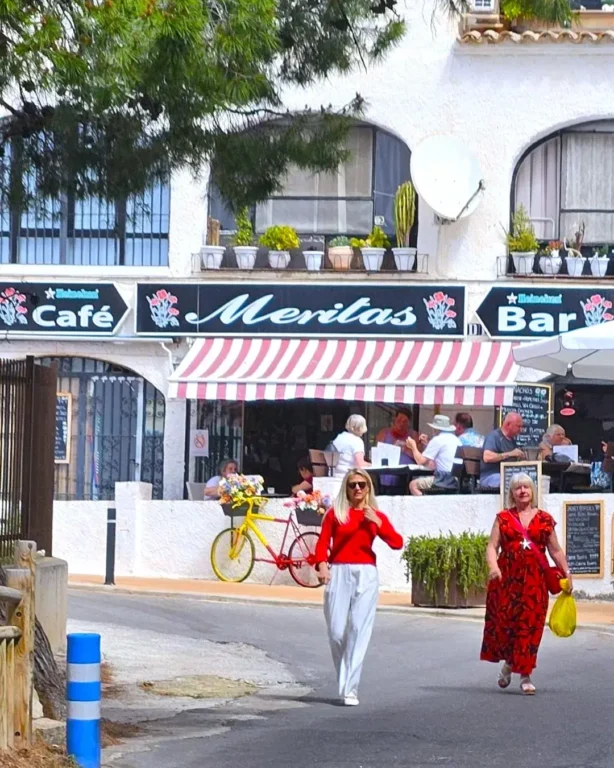
Bar Meritas, Benidorm.

Sanctuary at Café Bar Meritas

You may want to save Meritas for the return leg, where you can enjoy much deserved refreshments as well as a lovely lunch.

So a good idea might be to reserve yourself a table for when you are coming back on the downhill stint.

Continuing after Meritas, Sierra Dorada soon splits into two at the junction, where you will veer right and again slowly climb as you inch closer to Benidorm Cross – and don’t forget to look out for those signs pointing you in the right direction.
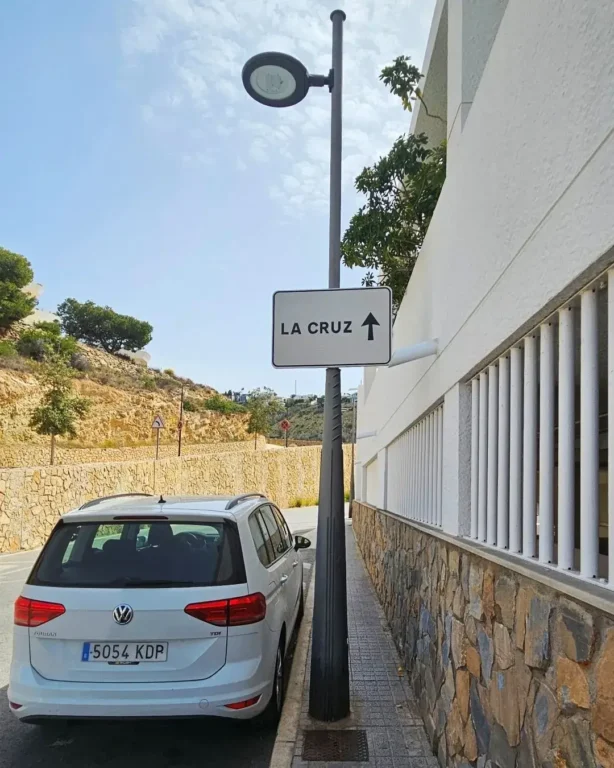
La Cruz Sign, Benidorm.

Follow that Sign!

STAGE 2

The Ascent — Entering Sierra Helada

This is the moment the walk genuinely transforms; as the smooth, paved lane winds its way through low Mediterranean scrub, mustard-coloured stone and aromatic wild rosemary.

The road follows the contour of the hillside, alternating between open sea views and fragrant stretches of pine woodland. On a clear day — and Benidorm receives more than 300 days of sunshine per year — the visibility is extraordinary.

You can pick out the distinctive limestone plug of the Peñon d’Ifach rising from the coast at Calpe, some 25 kilometres to the north.

The white villages of the Marina Baixa appear draped across the inland mountains.

And directly below, the astonishing forest of skyscrapers that makes Benidorm’s skyline unique in all of Europe.
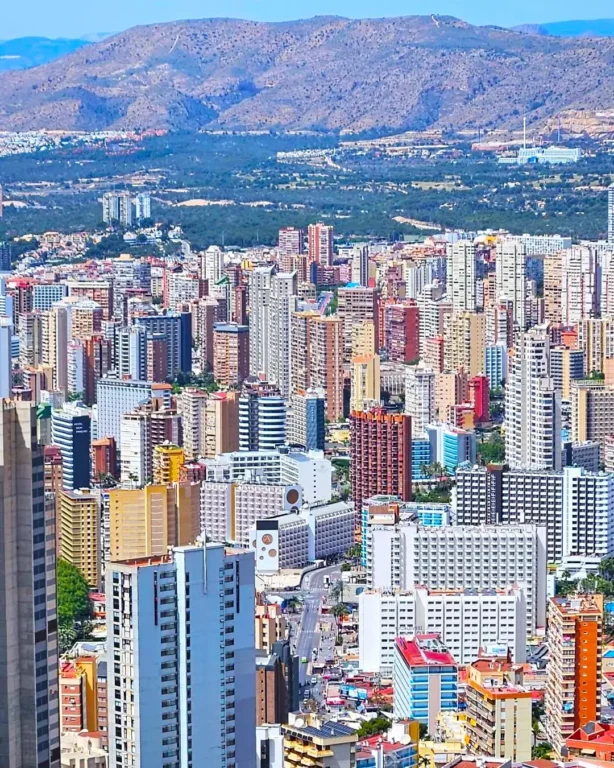
Benidorm Skyscrapers.

A jigsaw of hotels and apartments

At this stage of the walk, it is worth pausing to appreciate the Sierra Helada’s remarkable ecology. “The Frozen Mountain” — named by fishermen who observed how the cliffs caught the moonlight — is home to diverse Mediterranean flora and provides nesting grounds for Audouin’s gulls, Peregrine falcons and the rare Bonelli’s eagle.

Dolphins and even occasional sperm whales have been recorded in the waters below the cliffs.

After skirting the headland, the route swings inland and begins its more serious work.

The paved road — which here carries the wonderfully incongruous names of Avenida de Tokio and then Calle Taywan, a legacy of Benidorm’s optimistic internationalism during the 1970s development boom — begins to climb in earnest.

The gradient is honest but never brutal.

The road ascends in a series of sweeping bends, each one opening up a more generous panorama than the last.

Street lighting has been installed along this section, making an evening ascent perfectly feasible — though we would always recommend the late-afternoon light, when the limestone cliffs glow amber and the sea turns a deep, saturated blue.

As you climb higher, the views over Benidorm Bay become increasingly dramatic.
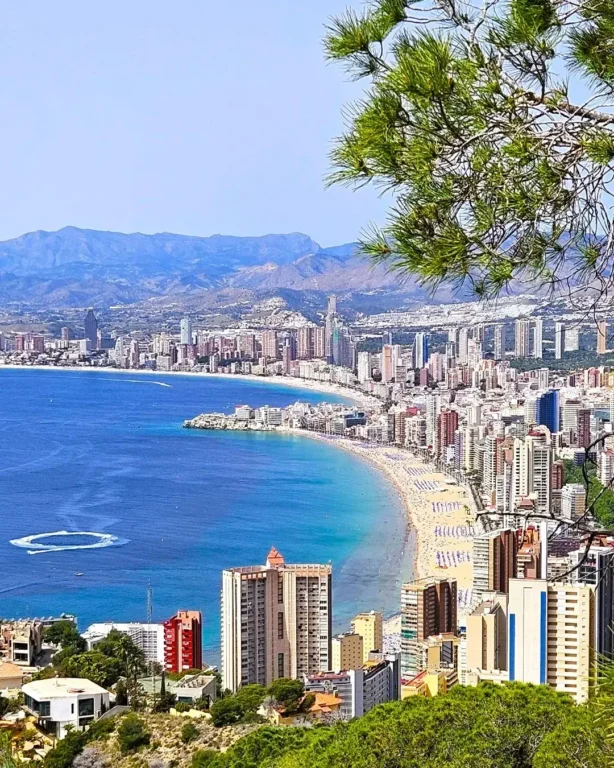
Benidorm beaches in the distance.

The Bay of Benidorm

The twin beaches of Levante and Poniente fight for prominence in the far distance.

And the compact bulk of the Old Town — its church tower, its terracotta rooftops, its headland jutting into the sea — sits between them like a full stop in a sentence written in sand.

From here, the scale of Benidorm’s ambition becomes fully legible: this is a city that built itself vertically precisely because it understood that the horizontal was too precious to squander.


as the smooth, paved lane winds its way through low Mediterranean scrub, mustard-coloured stone and aromatic wild rosemary

STAGE 3

La Creu — Journey’s End

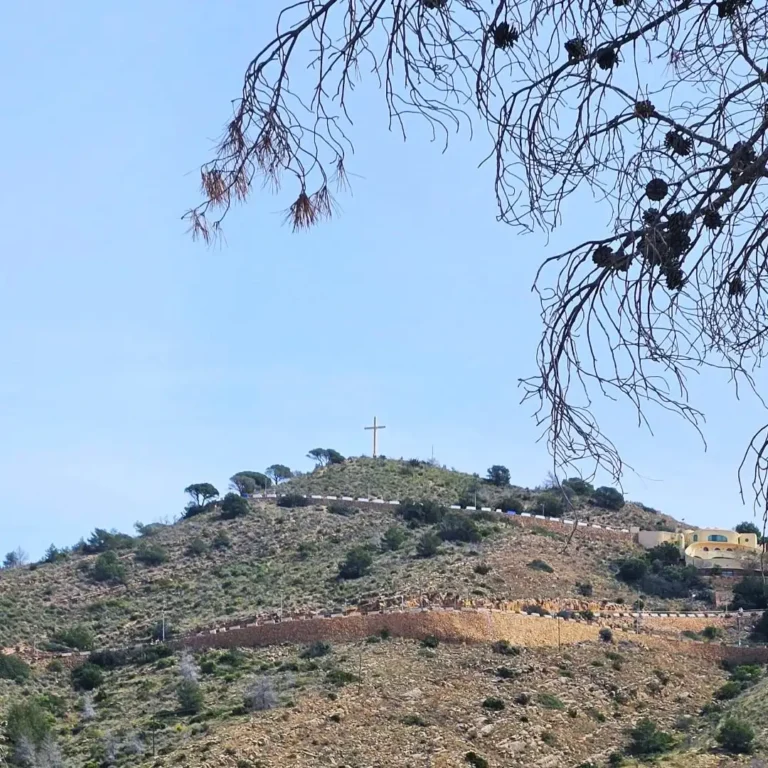
As the Cross comes into view you soon realise there is not too long to go, the final stretch.

Benidorm Cross in the distance.

A first glimpse of Journey’s End

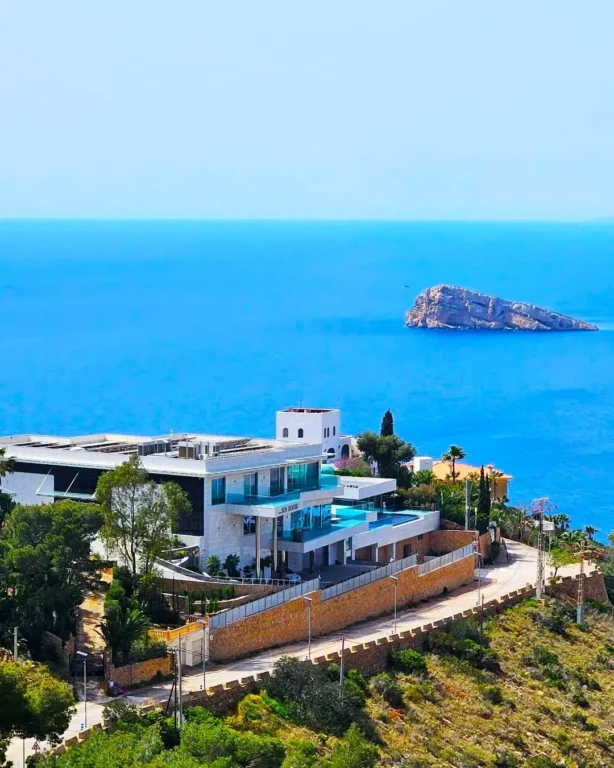
The hillside is dotted with villas you can only ever imagine living in.

But then it dawns on you that someone actually does wake up in the morning with these views – wow!

Sun House, Sierra Helada.

Magical villas are sprinkled across the landscape

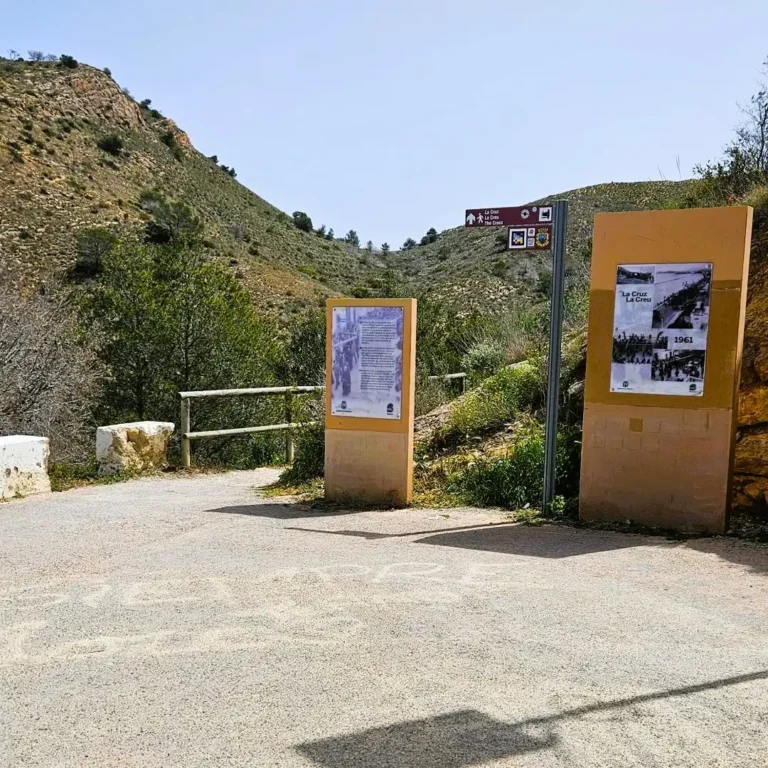
As you approach the end of the asphalt road – a place where a taxi can get you to if you don’t fancy the walk up – there are a couple of benches to catch your breath and some information on the history of La Cruz.

Entranceway to Bendiorm Corss.

Catch your breath, you have reached the entrance to La Cruz

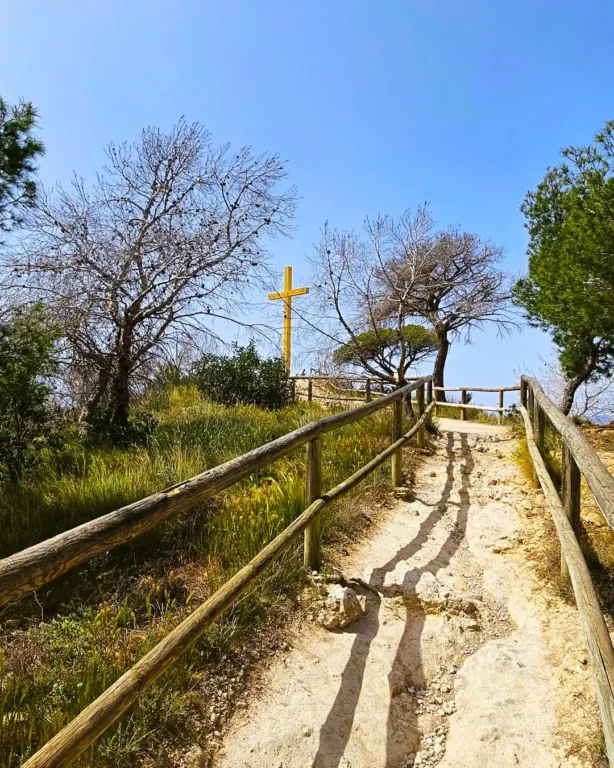
The next and final part of your odyssey is only about 50 or so metres but rocky and uneven so take your time and watch every step.

Rocky Road to The Cross, Benidorm.

Rocky Road – The Final Bit

And then you are there.

La Creu. La Cruz. The Cross of Benidorm.

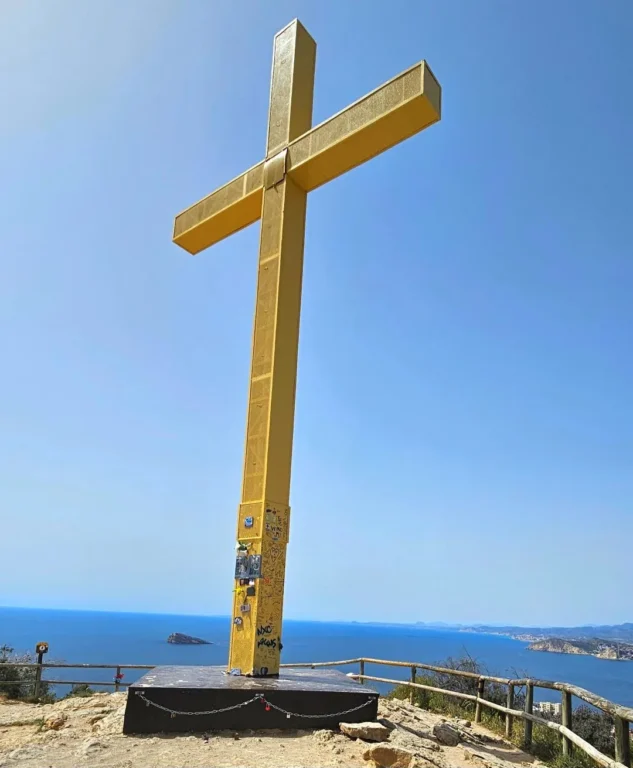
Standing roughly six metres tall on the southern tip of the Sierra Helada; simpler and more powerful than you might expect.

Benidorm Cross.

La Creu. La Cruz. The Cross.

A viewing platform surrounds its base and the lower part of the cross and the surrounding wooden railings are festooned with tributes — photographs pinned, handwritten messages placed with care, small mementos left by visitors who have found the place unexpectedly moving.

Many are in English. Some are in memory of loved ones.

The Día del Perdón tradition, it seems, has not entirely been forgotten.

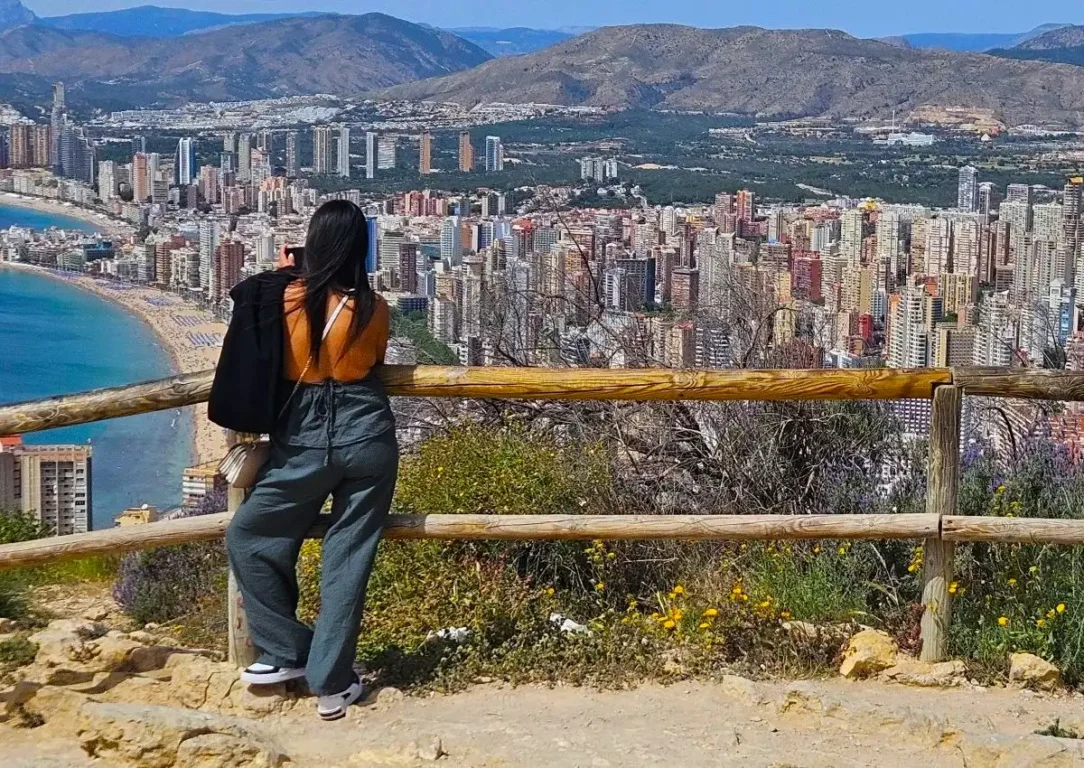
And the view from La Cruz is, quite simply, one of the finest urban panoramas in Spain.

The entire sweep of Benidorm Bay lies below you — Levante, Poniente continuing far beyond the Old Town.

The skyscrapers, from this elevation, look both magnificent and slightly absurd, like a Manhattan transplanted wholesale to a Spanish fishing village and told to get on with it.

Girl looking down over the resort of Benidorm.

Girl With a View

The distant peaks of Puig Campana and the inland sierras frame the picture to the north. And the Mediterranean stretches south to a horizon as clean as a ruled line.

Allow yourself at least 20 minutes here. The light changes constantly. The wind has opinions. The view rewards patience.

STAGE 4

The Descent – and a drink with your name on it

The easy way is to head back the way you came, primarily for two reasons – firstly, to take in Mirador Benidorm for pics if you didn’t do so on the way up and secondly, and more importantly, for that well deserved pint in Bar Meritas!

Glass of Cider at Bar Meritas, Benidorm.

That’ll do nicely, gracias!

And then you are there. La Creu. La Cruz. The Cross of Benidorm.

What to Wear What to Bring

The walk to La Creu is classified as moderate.

The paved road makes it accessible to most reasonably fit adults, but the sustained incline — and the exposed nature of the headland — demands some sensible preparation.

This is not a flip-flop walk.

Essential Kit List

  • Footwear: Trainers or light walking shoes are essential. The final cobbled 50 metres to the cross is steep and uneven. Flip-flops will end your day early and unpleasantly.
  • Water: At minimum one litre per person. In summer, take two. This is not a drill.
  • Sun protection: Hat, high-factor suncream and sunglasses are non-negotiable between May and October. The headland is entirely exposed and the Mediterranean sun has no mercy for the unprepared.
  • Layers: Even on warm days, the summit can be significantly breezier and cooler than the beach. A light layer in your bag costs you nothing and may save your day.
  • Snacks: There are no shops once on the main part of the route. A banana, an energy bar, a wedge of Spanish tortilla — something to sustain you on the final push to the cross.
  • Camera: Your phone camera will work perfectly well. But take more photographs than you think you need. The light at the top is exceptional.

When to Go

The best time to do the walk is either in the morning — starting around 9am to avoid the midday heat in summer — or in the late afternoon, arriving at the cross as the sun begins to lower over the mountains and the light turns extraordinary.

The cross is illuminated after dark, and an evening ascent followed by a night descent (the road is fully lit) is an entirely viable option and produces a truly unforgettable view of Benidorm blazing below you.

In high summer, July and August, the daytime heat makes a midday ascent inadvisable for most. In spring and autumn — arguably Benidorm’s finest seasons — the walk is a joy in almost any weather. In winter, come prepared for the possibility of cool winds at the summit, though temperatures are rarely too cold at this elevation.

The walk is accessible to most reasonably fit adults. However, the cobbled final section to the cross itself is not suitable for wheelchairs or pushchairs.

The viewing platform at the end of the paved road — just before the cobbled path begins — offers excellent views and is accessible to all. Visitors requiring car access for mobility reasons can request special permission from the Benidorm Town Hall Council of Mobility in advance.

Why The Cross Matters: More Than a Walk

There is a common assumption, held by those who have never been or have never looked beyond the hotel pool, that Benidorm is a place without depth.

The assumption is wrong, and the walk to La Creu is perhaps the most persuasive argument against it.

Stand at the foot of the cross and look back at the city.

What you see is not the tawdry cliché of package tourism run amok, but something stranger and more interesting: a town that chose, in the 1950s and 1960s, to bet everything on openness and internationalism when the rest of Spain was still buttoned up tight under Franco.

A town that built itself into the sky because it understood that space was precious and vision was not.

A town that erects a cross to protest the bikini and then, six decades later, uses that same cross as a beacon to draw the tourists in.

Benidorm is, in its way, one of the great Spanish stories of the 20th century.

And the view from La Creu tells it better than any guidebook.

Go. Climb. Look.

Then come back down for a cold cerveza in the Old Town and tell us it wasn’t worth every step.

Share Article: